Tuesday, December 16, 2014

Moyra Davey


            In Moyra Davey’s article she is very passionate about the value of an image however unplanned and informal it may be. Davey had been thinking of this concept for a while and kept her ideas on her computer, she goes on to say, “All of the quotes hover around the idea that accident is the lifeblood of photography.” Accidents in all forms of art are what make up something new and unexpected that everyone can appreciate in a new way.

            The article explains many different forms of art in which there are similarities that all have in common. One example is that writer’s block is not just for the writer, but for all art forms. Similarly, all art forms are to be appreciated for their little and accidental imperfections that may not originally be wanted. Without these little details, the images seem to lose their originality. With images and writing alike, Davey explains that one must let it carry itself away, accidents and all.

            I really enjoyed Davey’s perspective. The accidental image and letting ideas flow into directions not originally thought of by the artist makes them more beautiful. The unique mistakes are what make an individual’s work go to another level and beyond the norms of the art world.

Maria Lind


            In Maria Lind’s article, she discusses her experience curating as well as the idea of social practice in the art world. Lind places a great deal of importance on social practice, not just for the sake of the overall art world but also for the audience involved in it. Although the idea of social practice has not fully evolved in the art world, Lind expresses that this is where art should head in the direction of.

            The works Lind discuss were created in order to raise awareness of an issue through social experiences and bringing people together. An example of this is the website created called Schleuser.net, by artists Ralf Homann, Farida Heuck, and Manuela Unverdorben. These artists created the website in hopes of giving a better portrayal of immigrants. Although I question that this is an art movement, and not just a general idea in helping people and improving people’s perceptions, I do see how it does take a sense of art to successfully create this. Lind sees this as a unique and creative idea which is very obviously agreeable.

            Lind explains that the ‘minors,’ those who are not consumed but the art world such as the ‘majors,’ are the future of the art world and social practice. Sooner or later both the general art world and museums will expand their reach to social practice. They will see the value in the ideas of the ‘minors.’

Hito Steyerl

In Defense of the Poor Image


            Hito Steyerl’s article explained that there is value in all forms of media to some degree. At some point however, all images no matter what the media are obsolete. Whether it is time, technology, or the over use of an image, all images seem to inevitably die at some point. Steyerl argues that all images are worthy of respect no matter the quality, however I disagree.

            Once resolution is lost and overall quality I personally do not enjoy nor do I respect the image. Every image to me has an expiration date, after being edited and losing the quality it once had, there is no point to argue that the image has any sense of life to it. Progression is important in many aspects. Although Steyerl has a valid point that all art deserves some respect, at some point it is time to admit that it is out dated and time to move on and progress in the art world. The internet and social media does make society used to this wide array in quality of art, so a lot of it is valued now in the same way. However, just because people mindlessly view the internet and social media without thinking about the quality, it does not mean that there is no difference. The difference will be clear with the years to come.

            Steyerl makes a very interesting point that all images are to be respected, which I agree with in that all art should be respected. Then again, that does not mean that the image should still be used. It should be put to rest at some point, and make way for progression in the overall art world.

Jerry Saltz


Clusterfuck Aesthetic

            Art critic Jerry Saltz, a critic for the Village Voice, describes the idea that artists are displaying the artistic style of what he calls the, clusterfuck aesthetic. Saltz describes this style as, “grandiose and testosterone-driven,” and however harsh this may seem one cannot help when viewing the artists that he discusses that there is some truth to this.

            Going through the artists they each have their own style, however different and out of the box they may seem. My particular favorite is the Lee Walton's "Experimental Project." Personally I like the idea of participation in any art setting if done correctly and meticulously. Walton leads people around the city on basically a mysterious treasure hunt. Saltz explains that he goes to great efforts to get it just right and uses the little details to make it a unique piece. I am not sure what exactly draws me to think this is a great idea when it seems so basic, but I think as I said it is including anyone who wants to participate and using the little details to get it just right.

            Saltz picked many unique artists all with different mediums. I particularly enjoyed Walton’s work, making people run around the city on his own personally made treasure hunt. Bringing people together in different art forms and having them participate is an art form that should be more appreciated, even if it has a ‘clusterfuck aesthetic,’ Saltz brings to the light that it is just as valuable an art form.

Curating My Work, and My Plus 1


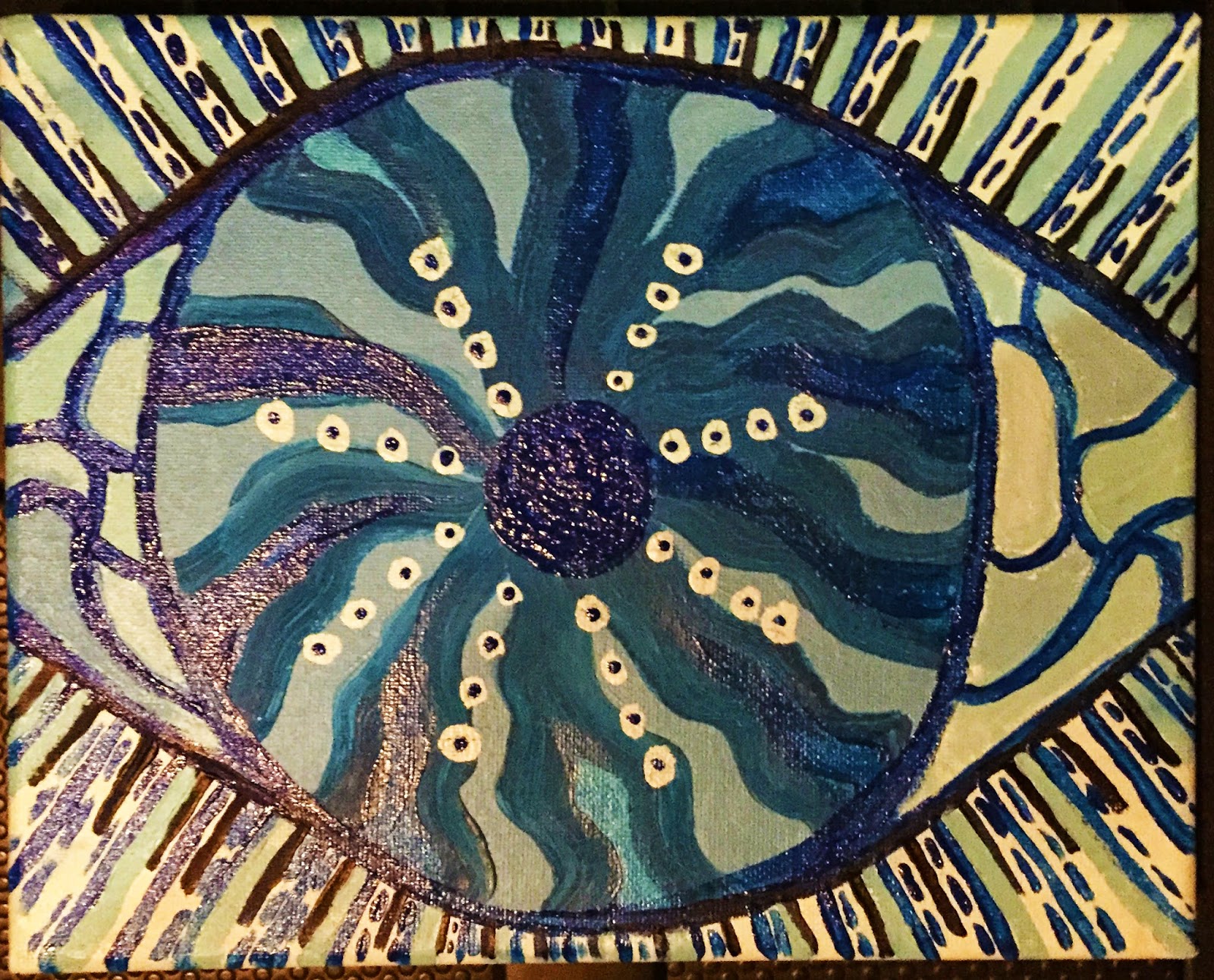
For this project the class had to come together to create a show. The theme chosen was a monochrome color show. It was to be filled with artwork from around the Reno area, inviting any artist to participate. Our class would then approve the pieces to make sure they fit into the chosen monochrome theme. However, there had been little to no submissions, perhaps because the theme may have been difficult or perhaps because of marketing challenges. Our class then chose to submit our own work, as well as have everyone find at least one other person's work to submit as well. I submitted 3 paintings for a triptych, each were as close to monochrome as I could comfortably achieve, and each consisted of one color. My plus one was from my roommate who likes to paint, and I had seen her painting a blue eye the night before. I asked if she could make it monochrome, all shades of blue, which she did, however I wish I had specified and clarified all in the same tone of blue. Then again, upon seeing all the submissions both my pieces as well as my plus one fit right in because we opened up the parameters a bit. We then installed the show, and had a one night showing. We worked together to hang the pieces properly in a gallery style. Although here and there, there had been issues in communication and not everyone was on the same page, in the end the show looked better than I thought it would and I enjoyed it. My favorite part was a students interactive piece in which she wore all white and you could paint on her. I learned that putting together a show takes a lot of time and that it is important to try and find a common goal in every aspect of the show.

Artist Lecture Scott Tsuchitani

              
Humor for Stereotypes

            Scott Tsuchitani is an artist who strives to show the idea that people still are very stereotypical in everyday life, however he does it in a humorous way through his art. Tsuchitani began the lecture by showing us a Christmas card that he sent his family of the perfect stereotypical Asian American family, which many of them fell for. He then proceeded to tell us of his work that branched off from this, such as his, "Memoirs of a Sansei Geisha: Snapshots of Cultural Resistance."

            The poster outside the museum seemed to play off as well as idealize the Japanese culture that people seem to get infatuated with. Tsuchitani proceeded to make his own flyers, changing the original poster so that the face was that of his behind the fan, as well as changing the title from, “Geisha, Beyond the Painted Smile,” to “Geisha, Perpetuating the Fetish.” Tsuchitani spread the flyers around and although he is an artist making a statement some would just argue it was more of an activist movement. However, this was very much so just an artist statement showing that people and museums think they know a culture so well, yet if it is not of your own culture that you have grown up into yourself, how can one draw these conclusions? Tsuchitani’s originally seemingly small idea spread and gave him a name, which he then continued to run with this idea in other works to come as well.

            I enjoyed Tsuchitani’s work, subliminal and somewhat humorous, yet a very noticeable statement that people should consider before they draw their own conclusions. I would want to do something similar in that I enjoy public yet subliminal art that makes people think. Tsuchitani’s work is successful in getting to the point, in the most polite, humorous, and intelligent of ways.


Monday, December 15, 2014

Exhibit Review Justin Quinn


The Meaning of Everything, Is Nothing?

            Justin Quinn’s exhibit was located in the Jot Travis Building, entitled, Not Everything Means Something, located at the University of Nevada, Reno. The exhibit was clearly organized and made it easy to focus on the work of Quinn without clouding the viewer’s mind, followed by other Dada works by other artists. Upon walking into the exhibit one is met with a wall that is covered immensely with nonsensical framed photocopies.
            These works are entitled as, Moby Dick volume 1 or 384,439 times E, and, Moby Dick volume 2 or 174,649 times E. The title of the piece has one looking for Moby Dick, only to question if it is even relevant. This is the piece I was most drawn to. However nonsensical the piece may seem, it is captivating and makes it’s audience want to return to it. One either returns because it is visually unique and attractive or because it makes one ponder its significance as mankind does. I returned out of curiosity, although I can’t say I necessarily enjoyed this work personally, I want more from it visually.

            Quinn’s work unquestionably takes the form of the art movement Dada. Dada is one of the hardest art movements to define, and although Dada had taken off in the early 1900’s, Quinn proves that it is a timeless movement. Dada cannot be contained to just one time period, as well as it cannot necessarily be defined. And although the thought of a somewhat undefinable art period may be frustrating, it also undeniably intriguing. I like the overall idea of his work and how it makes me think, however I am not a huge fan of it in a visual sense. It bores me and I wish there was more going on.