Tuesday, December 16, 2014

Jerry Saltz


Clusterfuck Aesthetic

            Art critic Jerry Saltz, a critic for the Village Voice, describes the idea that artists are displaying the artistic style of what he calls the, clusterfuck aesthetic. Saltz describes this style as, “grandiose and testosterone-driven,” and however harsh this may seem one cannot help when viewing the artists that he discusses that there is some truth to this.

            Going through the artists they each have their own style, however different and out of the box they may seem. My particular favorite is the Lee Walton's "Experimental Project." Personally I like the idea of participation in any art setting if done correctly and meticulously. Walton leads people around the city on basically a mysterious treasure hunt. Saltz explains that he goes to great efforts to get it just right and uses the little details to make it a unique piece. I am not sure what exactly draws me to think this is a great idea when it seems so basic, but I think as I said it is including anyone who wants to participate and using the little details to get it just right.

            Saltz picked many unique artists all with different mediums. I particularly enjoyed Walton’s work, making people run around the city on his own personally made treasure hunt. Bringing people together in different art forms and having them participate is an art form that should be more appreciated, even if it has a ‘clusterfuck aesthetic,’ Saltz brings to the light that it is just as valuable an art form.

Curating My Work, and My Plus 1


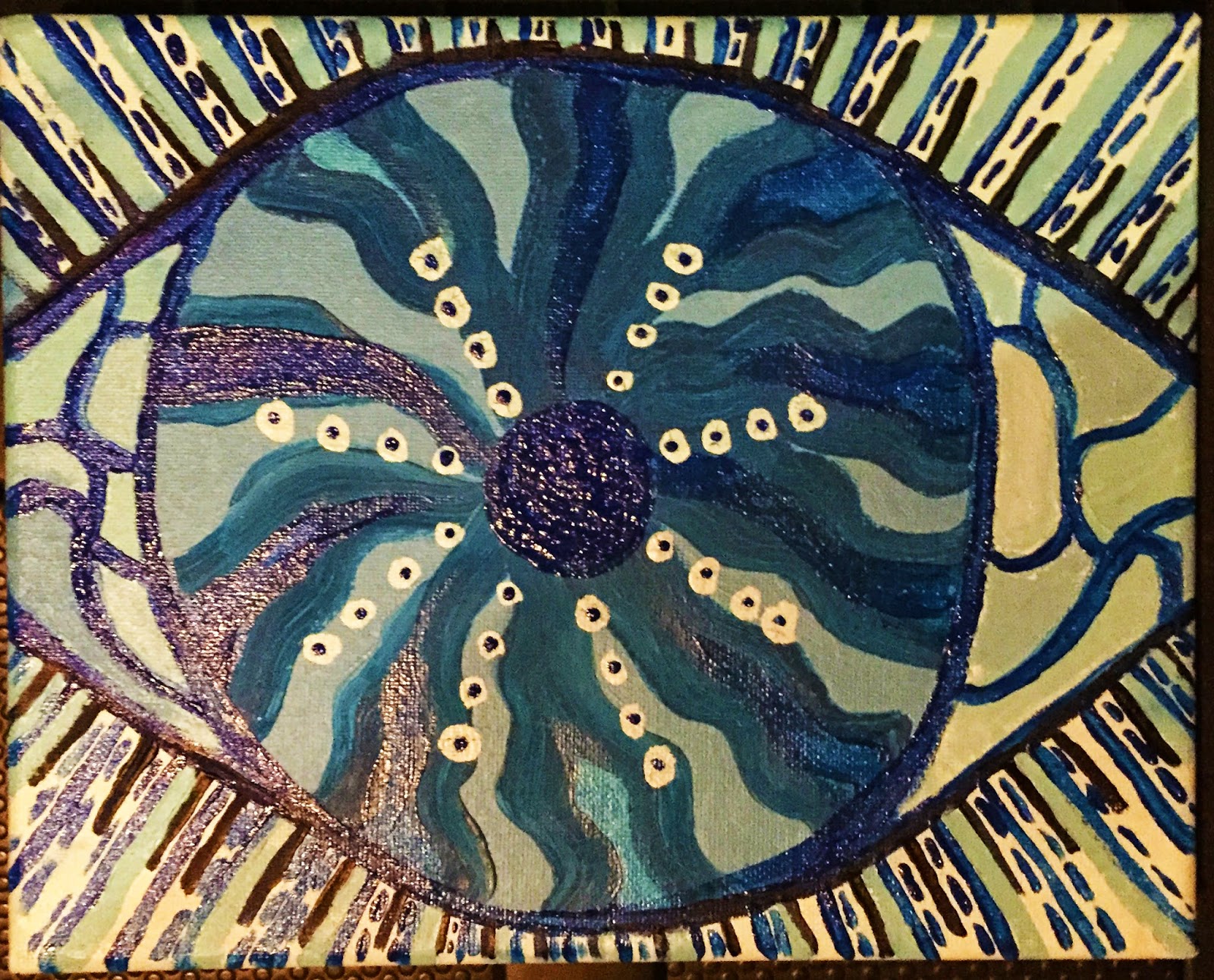
For this project the class had to come together to create a show. The theme chosen was a monochrome color show. It was to be filled with artwork from around the Reno area, inviting any artist to participate. Our class would then approve the pieces to make sure they fit into the chosen monochrome theme. However, there had been little to no submissions, perhaps because the theme may have been difficult or perhaps because of marketing challenges. Our class then chose to submit our own work, as well as have everyone find at least one other person's work to submit as well. I submitted 3 paintings for a triptych, each were as close to monochrome as I could comfortably achieve, and each consisted of one color. My plus one was from my roommate who likes to paint, and I had seen her painting a blue eye the night before. I asked if she could make it monochrome, all shades of blue, which she did, however I wish I had specified and clarified all in the same tone of blue. Then again, upon seeing all the submissions both my pieces as well as my plus one fit right in because we opened up the parameters a bit. We then installed the show, and had a one night showing. We worked together to hang the pieces properly in a gallery style. Although here and there, there had been issues in communication and not everyone was on the same page, in the end the show looked better than I thought it would and I enjoyed it. My favorite part was a students interactive piece in which she wore all white and you could paint on her. I learned that putting together a show takes a lot of time and that it is important to try and find a common goal in every aspect of the show.

Artist Lecture Scott Tsuchitani

              
Humor for Stereotypes

            Scott Tsuchitani is an artist who strives to show the idea that people still are very stereotypical in everyday life, however he does it in a humorous way through his art. Tsuchitani began the lecture by showing us a Christmas card that he sent his family of the perfect stereotypical Asian American family, which many of them fell for. He then proceeded to tell us of his work that branched off from this, such as his, "Memoirs of a Sansei Geisha: Snapshots of Cultural Resistance."

            The poster outside the museum seemed to play off as well as idealize the Japanese culture that people seem to get infatuated with. Tsuchitani proceeded to make his own flyers, changing the original poster so that the face was that of his behind the fan, as well as changing the title from, “Geisha, Beyond the Painted Smile,” to “Geisha, Perpetuating the Fetish.” Tsuchitani spread the flyers around and although he is an artist making a statement some would just argue it was more of an activist movement. However, this was very much so just an artist statement showing that people and museums think they know a culture so well, yet if it is not of your own culture that you have grown up into yourself, how can one draw these conclusions? Tsuchitani’s originally seemingly small idea spread and gave him a name, which he then continued to run with this idea in other works to come as well.

            I enjoyed Tsuchitani’s work, subliminal and somewhat humorous, yet a very noticeable statement that people should consider before they draw their own conclusions. I would want to do something similar in that I enjoy public yet subliminal art that makes people think. Tsuchitani’s work is successful in getting to the point, in the most polite, humorous, and intelligent of ways.


Monday, December 15, 2014

Exhibit Review Justin Quinn


The Meaning of Everything, Is Nothing?

            Justin Quinn’s exhibit was located in the Jot Travis Building, entitled, Not Everything Means Something, located at the University of Nevada, Reno. The exhibit was clearly organized and made it easy to focus on the work of Quinn without clouding the viewer’s mind, followed by other Dada works by other artists. Upon walking into the exhibit one is met with a wall that is covered immensely with nonsensical framed photocopies.
            These works are entitled as, Moby Dick volume 1 or 384,439 times E, and, Moby Dick volume 2 or 174,649 times E. The title of the piece has one looking for Moby Dick, only to question if it is even relevant. This is the piece I was most drawn to. However nonsensical the piece may seem, it is captivating and makes it’s audience want to return to it. One either returns because it is visually unique and attractive or because it makes one ponder its significance as mankind does. I returned out of curiosity, although I can’t say I necessarily enjoyed this work personally, I want more from it visually.

            Quinn’s work unquestionably takes the form of the art movement Dada. Dada is one of the hardest art movements to define, and although Dada had taken off in the early 1900’s, Quinn proves that it is a timeless movement. Dada cannot be contained to just one time period, as well as it cannot necessarily be defined. And although the thought of a somewhat undefinable art period may be frustrating, it also undeniably intriguing. I like the overall idea of his work and how it makes me think, however I am not a huge fan of it in a visual sense. It bores me and I wish there was more going on.

Light Box Project "Stained Glass Owl"


For this project I really wanted to explore the relationship between color and light. I had painted the owl on canvas with acrylic, which is originally part of a four piece work. I photographed the owl then edited it using Photoshop. Upon talking about my idea with the class, before I had finished fully editing, the class said it reminded them of stained glass, so I wanted to run with that idea and see what I could do with it. To achieve this look I knew the background would have to go with the owl as well. So, I layered the owl's feathers in the background, and felt as though it had achieved the stained glass look I was going for. Overall, I believe my attempt at using both color and light successfully in the light box was successful.

Tuesday, December 9, 2014

Final Project "ANUNCIO"

 
Sophisticated Advertisements
Coming to The University of Nevada, Reno


The University of Nevada, Reno, is now allowing advertisements in the quad in order to keep the University from going under financially. The quad is also a Jefferson Academic Village,  which is listed on the National Register of Historic Places, as the campus core follows Thomas Jefferson's design for the University of Virginia Lawn. The advertisements are also that of other countries, such as Spain, France, and Italy. Although some people debate as to if this will ruin the beauty of the quad and all the University stands for historically, unfortunately there is no other option. This is directly associated to the abundance of advertisement in the canals of Venice, Italy in which advertisements from America's capitalization has began to take over. Now America must face the fact that before their very eyes, the country is in danger and must get help from other countries to stand on its own feet. Face to face, everyday, American's will be reminded of other powerful countries taking over the United States financially and in their identity.


Advertising all over the world is more of a problem then many would realize. There is more to the advertisements than meets the eye. Not only are the ugly and in the way of the environment that we could have, they also promote capitalism, specifically the capitalist ideas of America. The advertisements are meant to pull people in the same direction, in hopes of getting society to all think the same. Politicians and world leaders to do want people to stray into their own direction of life, but want them all to be like robots. Do what they want you to do, buy what they want you buy, and fall into their capitalist trap.
 
The Situationists are a big part of what inspired me to do this project. Upon traveling to Spain, I realized the advertisement industry there was nothing compared to what I was used to in the United States. Then, the only advertisements I had seen, were of American companies and franchises. America is constantly pushing their ideas and capitalist ways on other countries. In, Perspectives for Conscious Alterations in Everyday Life, by Guy-Ernest Debord, he says, "To fail to criticize everyday life today means accepting the prolongation of the present thoroughly rotten forms of culture and politics, forms whose extreme crisis is expressed in increasingly widespread political apathy and neoilliteracy, especially in the most modern countries," (Debord). It is important to question the world around you, and not to accept everything but to have your own voice in society.
 
 Not questioning the American system is to live in acceptance of a system that is encouraging society's ignorance to their own benefit. I believe a big part of myself had been living in ignorance to the advertisements before traveling to Spain. I had learned of the advertising problems in school, but seeing them with my own eyes made me really realize the bigger issues. Once I saw how differently they all lived and how differently it looked there, I knew that America was pushing all these selfish and moronic ideas down our throats. When in Spain it was clear to see how annoying America was, imposing itself in these countries, especially in places of historical and beautiful significance for Spain. The advertisements and the motives behind them are ugly.
 
I decided to make my advertisements, ugly, pointless, and obnoxious, just as the few advertisements from America had made me feel in Spain. I made 4 large boards, and 7 smaller sized boards, and placed them in the beautiful and historically significant quad on campus. I spray painted them a ridiculous orange and purple, then wrote the word, "ADVERTISEMENT," in the languages Spanish, French, and Italian. The other languages used, are to show how it feels to watch another country with a different culture try to come and impose themselves in your beautiful home. I hung them from trees, posts, on buildings, statues and benches. I also left a small light box outside of a building in the early morning, which was quickly removed.
 
I enjoyed this project because I thought it successfully had shown all that I was trying to portray. However, if I had more money to fund the project I would have had more posters and made them more professional, yet still unattractive and with a pointless sense to them. In the critique some had wondered why I did not put actual advertisements up or at least mimicked them more. The reason I knew I did not want to do that immediately was because I knew it did not matter to me what the advertisement said. All advertisements have the same ugly idea behind them, I wanted them to look generic and as hideous as I believed they were. I would have also taken my photographs closer after hearing the critique, but at the time and just wanted to make it clear it was ruining the beautiful quad. Just as the Situationists point out, it is important to question the world around you, and not accept it because that is exactly what politicians and leaders want you to do, so as not to break from their mold.
 
America has many amazing qualities that should not be taken for granted. When I was in Spain, I missed my home for many reasons that I would have never realized. However, more and more it seems as though it is consumed with capitalism and falling into the trap of a power hungry nation, striving to consume everything selfishly. The Situationists have the right idea, questioning the world around them as well as thinking of clever ways to express these ideas. Advertisements may not be so noticeable to everyone, I didn't necessarily realize the problem until it was in front of me, even though I was aware of the problem. At some point these advertisements will be an obvious sign as to why American is getting ugly. The question then is who will notice these ugly advertisements and fight the ideas that are so easily digested by the public.


Tuesday, October 21, 2014

Society of the Spectacle, Situationists Review


Situationists

            The Situationists included people in the movement in which the world around us, more so the modern world, is questioned. Technology, capitalism and predisposed ideas of how the world should be, are what gets this movement noticed. These are all ideas that spark and provoke the idea of revolution in mankind. By exposing the world around us for what it really is and showing what it is turning into, people are drawn to this and almost have the urge to join in.               

            Instead of accepting the world around us and adapting to it like we are always told to do from a young age, the Situationist’s idea is just the opposite. Question everything, expose it to the world and show what is really going on so that the world can make their own decisions. In, Perspectives for Conscious Alterations in Everyday Life, by Guy-Ernest Debord, he says, "To fail to criticize everyday life today means accepting the prolongation of the present thoroughly rotten forms of culture and politics, forms whose extreme crisis is expressed in increasingly widespread political apathy and neoilliteracy, especially in the most modern countries," (Debord). It is important to question the world around you, and not to accept everything but to have your own voice in society. One of the clearest examples and a personal favorite that we reviewed of this was the Yes Men. Although this movement began in the 1900’s, it is timeless in the fact that it can still be successfully done and relevant even now. The Yes Men, create websites that look like big actual companies that are in the wrong in some way or another usually. Then, people hire them to come speak at big hearings, conventions or even a very public news cast. Then, that is when their performance starts, throwing these companies under the bus, or exposing them. However, it is done in a hilarious way and witty. Although I am sure they have had many legal battles with what they are doing, some companies do not even want to fight back, because then they would have to discuss the point that the Yes Men hit on to begin with.

            The Situationists are needed in the world. Especially today where the modern world full of technology and capitalism are taking over. The idea of accepting and adapting is ignorant, the world should be questioned, and the Situationists take that leap and make others more comfortable with the idea as well.